Search This Blog

Saturday, June 13, 2015

Tashkent

We started our Uzbekistan trip in Tashkent.  After a night of sleep, we had a day to see the sights.  The following morning, we were scheduled for an early flight to Nukus and a drive to Khiva.

The first order of business was exchanging money.  There appeared to be very few ATM's in Uzbekistan, and credit cards seemed to be accepted only rarely (in some carpet shops, for instance).  Even the tour agency we booked through wanted their final payment in cash upon arrival.  This was sort of a new situation for me, needing to anticipate how much cash I was going to need for the entire trip, keeping in mind how uncomfortable I am carrying around large amounts of cash.  In addition to these considerations, there was a rather large difference between the official dollars-som exchange rate, and the "unofficial" one.  I was a little uncomfortable going the unofficial route, but fortunately, it all turned out okay.  Interestingly, I noticed that souvenir merchants were using an exchange rate in the ballpark of the unofficial one when giving prices in both dollars and som.

We exchanged $200 initially, and it yielded quite a stack of bills.  If any prospective Uzbekistan travelers are reading this, I highly recommend bringing some sort of bag to carry it all in.  You won't be able to fit much into a standard size wallet.

Our fat stacks
After a hotel breakfast, our guide picked us up to take us around the city.  Tashkent was beautiful.  It reminded me a lot of Almaty, with its tree-lined streets and mix of old and new.  Some people were clearly doing quite well, as evidenced by some of the very new buildings and western stores.  Unfortunately, this was not the case for everyone.  I saw quite a few children begging over the course of the day, which always makes me sad.

Our first stop was the Khazrati Imam complex.  There was a lot to see, and lots of merchants selling souvenirs.  My details about a lot of the sites will be pretty incomplete, since my mind is like Teflon with information while I'm looking around and taking pictures.


The next step on our itinerary was Chorsu Bazaar.  It was large, with multiple sections for both food and stuff of all varieties.  We bought cherries and cashews to snack on.

Molds for wonderful Uzbek bread!


Looking down on the meat section
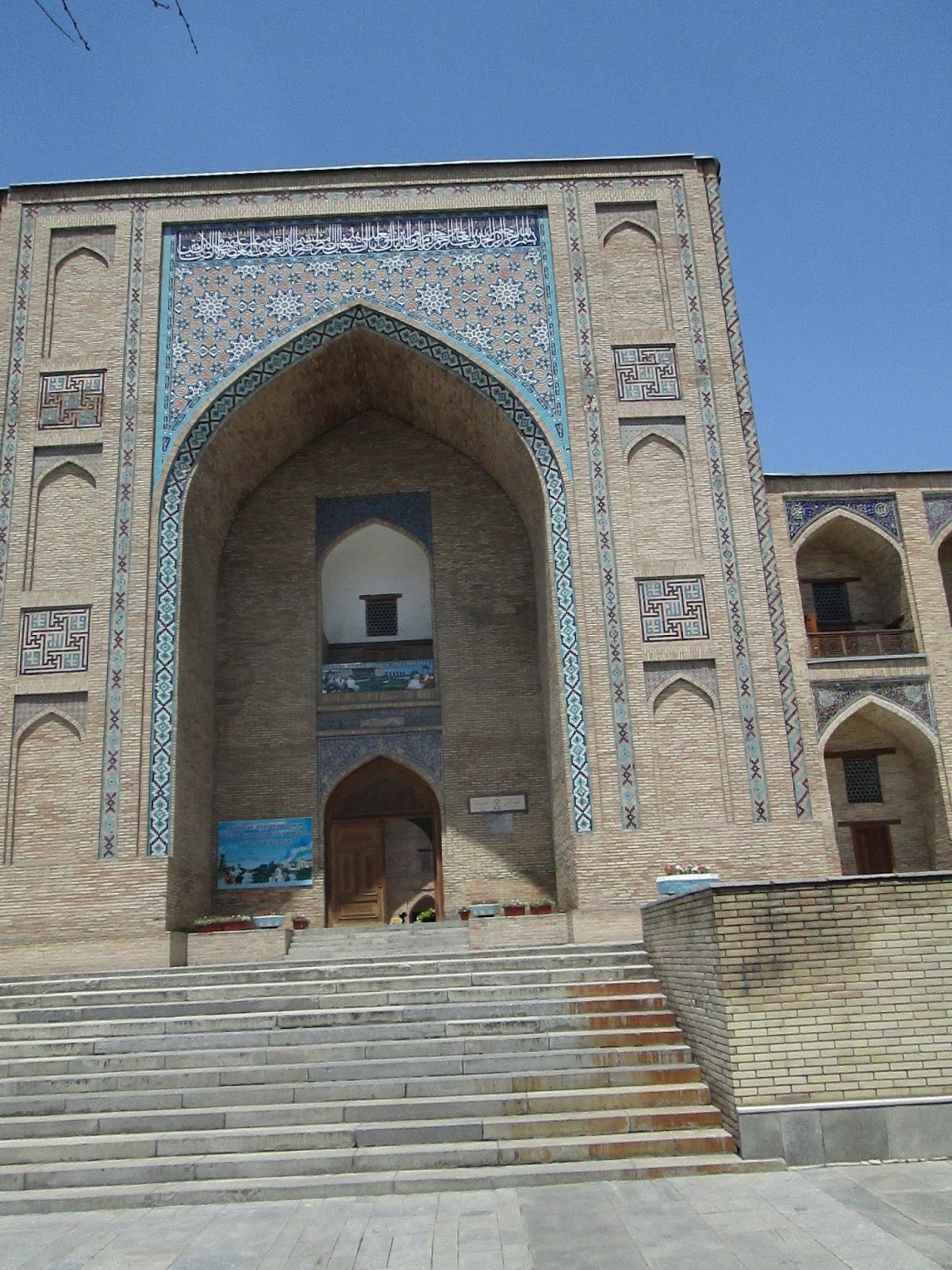
We also saw the Kukeldash Madrasah from the outside.


We had lunch at a restaurant famous for its plov.  You could get it with various types of meat in it, and with chicken and quail hard boiled eggs.  Much to my delight, the plov contained chickpeas.  We also got a wonderful tomato and cucumber salad on the side.  After spending the winter avoiding the crunchy tomatoes available in Astana, it was wonderful to eat good tomatoes again.  I sat next to our driver during lunch, and he brought out his cellphone and showed me pictures of his wife and daughters, which I thought was great.

After lunch, we walked around some more and then took a short metro ride in order to see Tashkent's famous metro stations.  Unfortunately, photography in the metro stations is forbidden, and there were plenty of police in every station we passed through.  Their designs were beautiful, though, and as a fan of mass transit, I was happy to see them.

It was an extremely hot day, so we took a rest in the hotel after that.  For dinner, an Uzbek friend of the friend who organized the trip had a lovely suggestion for a restaurant on the water.  We ate sitting on cushions around a low table.
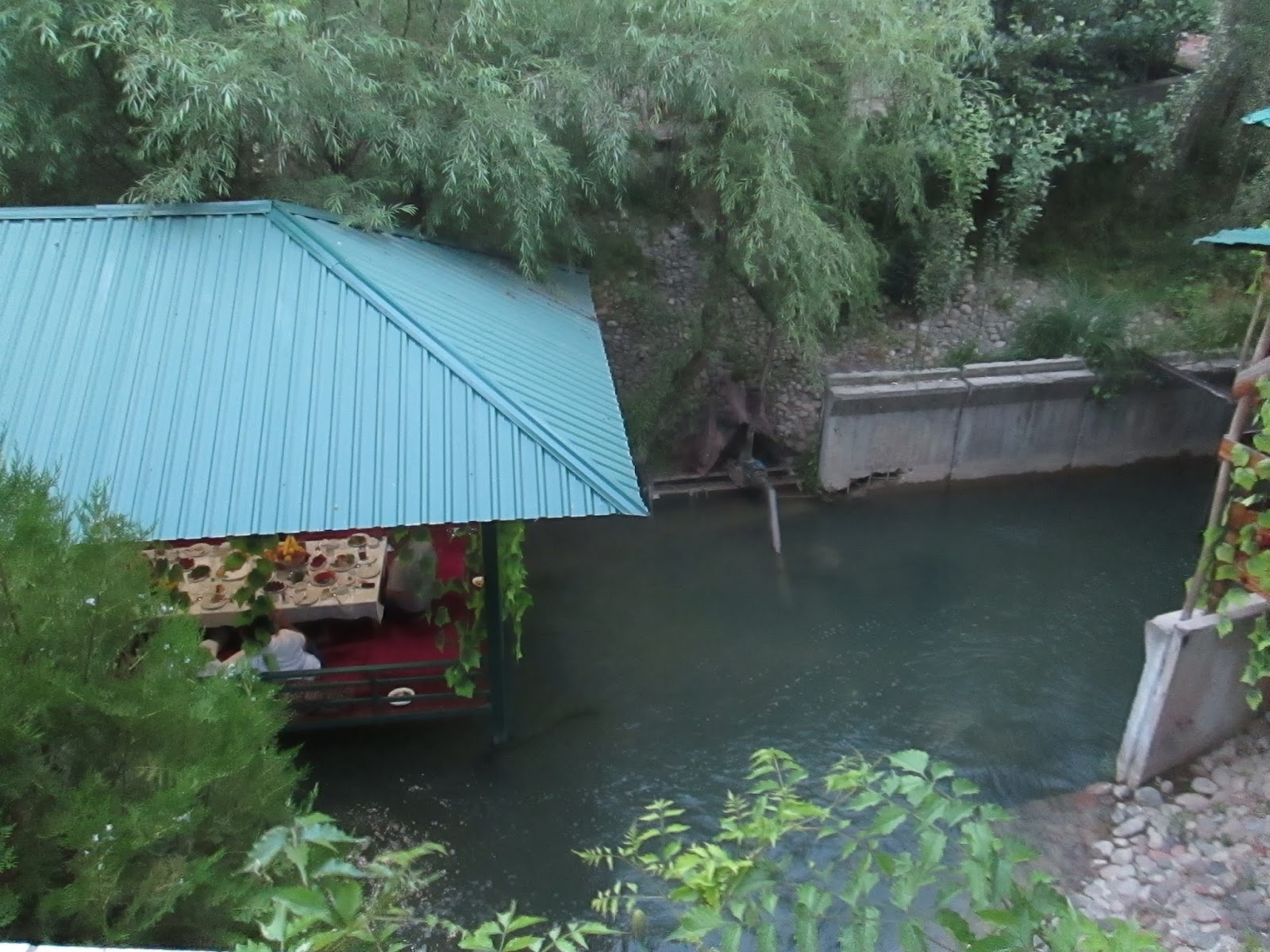

The food was great, too.  The only fly in the ointment was actually the flies.  They were attracted to the light above our table and kept dropping into our food.  I looked at the ground beside our table and saw an amazing avocado green slug.  I'm not usually a fan of creepy crawlies, but I actually think slugs are pretty cool, and I liked the size and color of this one.


Then it was back to the hotel for a little sleep before our early morning flight to Nukus!  We didn't have a lot of time to spend in Tashkent, but we liked it very much.  Scott and I were talking, and it turned out we had both been envisioning a place like Tashkent when we decided to move to Astana--a city with many modern features, but a lot of elements of traditional culture.  This may have been naive thinking considering just how new Astana is, but it was nice to see a city able to modernize but still keep many of its charming older attributes.

Saturday, June 6, 2015

Uzbekistan!

Scott and I returned from a week long trip to Uzbekistan with some of our friends in the wee hours of the morning.  Aside from unfortunately breaking my twelve year non-vomit streak in Samarkand, we had a wonderful time!  More stories and pictures are forthcoming once we get ourselves settled for the summer.

Getting there required a lot of advanced preparation, much of which was undertaken by one of our wonderful colleagues and friends here.  Getting a visa to Uzbekistan can be problematic, at least for US citizens.  You need a letter of invitation to apply for a visa, and probably the easiest way to get this for most tourists is to go through a tour company, who will also create an itinerary for you.

Once our tour company had letters of invitation for us, we needed to actually apply for visas.  There were two clear obstacles here.  One is that we all live in Astana, but the Uzbek embassy is in Almaty, which is either an overnight train ride or a short flight away.  The other obstacle was that they wanted cash payment--in US dollars--for visas.  Fortunately, our friend who organized the trip needed to go to Almaty for a conference, and he kindly offered to take all of our passports and great wads of cash to the embassy for us.  Amazingly, this all worked out.  The official he dealt with asked if he had our trust, and once he assured him that he did, he processed the visas.  In terms of dollars, the local bank we deal with here allows us to withdraw dollars from the ATM, but seems to only have $100 bills.  The visas for me and Scott came to $330 total.  Luckily, our friend had collected some smaller bills, so we were able to work out the amounts.

We flew out of Astana on a Friday evening, which turned out to be a dreadfully crowded time at the airport.  We had checked in online earlier in the day, but the system would not let us print out boarding passes, so we had to stand in line.  This wouldn't have been so bad, except that the prevailing system seems to be to reward people who get to the airport late by allowing them to cut  in front of everyone else.  To be clear, I'm fine with helping people with tight connections at airports, but the Astana airport has few if any connecting flights, and I think that people who don't plan their time are in a different category.  The same thing happened at passport control, and I started to despair ever being able to leave.

But leave we did.  At some point during the flight, flight attendants started handing out customs forms for Uzbekistan.  For reasons best known to themselves, they handed me and Scott one form each, although we were going to need two.  Naturally, we didn't know this until we got off the plane.

We reconvened with our group when we landed, and it turned out that some people were given two forms to fill out.  Nobody was particularly clear whether they needed to complete the second form, or if it was just provided in case they made mistakes on the first form.  As members of our group individually went through the line in customs, it became apparent that the standard practice is for the customs officials to keep one copy of the form, and to stamp the other copy to give back to us.  We would then need to hold on to our copy for the duration of the trip.  I rushed around the customs area, looking for additional customs forms in English for me and Scott to fill out.  Some members of our group were allowed through with only one form completed, so Scott went through with only one copy completed, while I hastily scribbled on my copy.  The customs official decided to lay down the law with Scott, and took the one completed copy and only gave Scott one stamp on the copy he had, rather than the two stamps everyone else got.  So when I got through the line, I found Scott hastily completing his form so he could get the precious stamp.  However, nobody was willing to give it the second stamp!  One of our Russian-speaking friends intervened and asked several officials very nicely.  They each kept sending us to someone else, and finally someone (I think the original official) relented.

Crisis averted.  I felt quite uneasy, both because we had to keep track of extremely flimsy customs forms for the duration of our trip and because we'd had such difficulty getting our paperwork in order prior to leaving the airport.  With that, we headed off to our hotel in Tashkent.  I'm happy to say our Uzbekistan experience improved markedly after leaving the airport.

Monday, May 25, 2015

Two Necklaces and a Bracelet

With various projects that aren't related to beads (and, well, my job), I didn't have too much time for beading during the semester.  Now that the semester is over, I think I've made up for lost time.

The first project I finished was one I had been thinking about for a long time.  Scott got me a wonderful, large, colorful pendant as an anniversary gift a few years ago.


I loved it, but it took me a long time to figure out how to use it.  I think very large pendants usually benefit from being surrounded with large beads and design elements.  At the same time, I didn't want the surrounding beads to detract from the pendant.  I ultimately ended up stitching beaded triangles in colors that complemented the pendant, and stringing those in sections along the sides of the necklace.  Other beads include vintage black glass beads; drop beads in clear, yellow, and brown glass; and large pink seed beads. I think the beaded triangles add a lot of visual weight without actual weight, which makes me happy when I wear the necklace.

Sorry for the questionable photo--I miss my light box!

The next necklace I made incorporated a small octopus pendant made by Cynthia Thornton that I had been unable to resist.  This pendant posed a different design challenge.  It is fairly small and dainty, and I didn't want the surrounding necklace to overwhelm it.  However, I didn't want the necklace to be underwhelming, either.  My compromise was to include a double strand section at the front of the necklace.


The beads I used are labradorite "chip" beads, which are much prettier in person than in these photos.  I often find chip beads difficult to work with because of their irregular shapes, but in this case, they helped me achieve the natural look I was going for.  The octopus rests on a small length of chain (from my chain scraps, yay!).

The most recent thing I made was a narwhal bracelet.  Green Girl Studios makes wonderful metal (mostly pewter) beads.  My favorite ones feature animals, and I was very excited when they came out with a narwhal design.  Because of the placement of the holes, I thought a bracelet made the most sense.  I decided to dip into my collection of vintage glass beads and made lots of wired dangles with those and purple niobium headpins.  This was my first time working with niobium, and I liked the contrast of a type of metal I think of as a more modern design element with my vintage glass beads.  Also, I tend to hoard my vintage glass beads, and it was oddly liberating to use so many on one project.


Wishing everyone time for the hobby of your choice!

Saturday, May 23, 2015

Palmyra


The recent news of ISIS seizing Palmyra made me think back to my own trip there, when circumstances in Syria were very different.  I studied in Syria for about a year from 2004 to 2005, and I visited Palmyra in the spring of 2005.

I don't remember exactly how long my bus ride there was from Damascus, where I was living, but it was certainly a number of hours.  Palmyra's ruins were considered a "must see" in Syria despite their distance from the major cities, and, as might be expected, a good number of the people there made their living on tourism.  There are a lot of wonderful sites for both locals and visitors to see all over Syria, but this was the only place I visited in the country where restaurant owners routinely brought out guest books for me to sign.  It was also the only place where I saw a restaurant very prominently advertise a good review they had gotten from Lonely Planet several years before.

I thought I would share a few pictures I took there.  I'm wishing peace and safety for the people and cultural treasures of Palmyra with all of my heart.

Entrance to Palmyra


Side View of Temple Bel


View of Mountains and Palm Trees


Amphitheater


Citadel and Columns


Wednesday, May 20, 2015

Turkistan

On the last day of our trip to southern Kazakhstan, some of us went to visit some sites in and around the historic city of Turkistan (also spelled Turkestan).  Our choices were to be taken hiking in a canyon or go to Turkistan, and while both options sounded tempting, Turkistan won out in the end since Scott is a historian, and particularly since he has been teaching a class on the history of Kazakhstan.

The place where we were staying arranged transportation, so early in the morning, those of us going to Turkistan loaded up in a minibus.  Our first stop was at the local train station to pick up some other travelers who were joining us.  There isn't much to say about them.  It seemed clear to me and all the people I had been traveling with that they were experiencing some sort of awful tension among themselves.  There might well have been a good reason for it, but suffice to say that this won't turn into one of those cheesy stories about making lifelong friends out of people we met on a daylong tour.

We rode in the bus for quite a while, enjoying views of red poppies and small local mosques from the window.  The first stop we made was to see the ruins of Otrar.  According to one of the Russian speakers in our group, the minibus driver commented that there was nothing to see there, just a pile of rocks.  Truthfully, to the uninitiated, his comment seemed rather apt.  Scott told me to think of it as evidence of Chinghis Khan's destruction.


Our next stop was the Aristan-Bab Mausoleum, for an early mentor of the Turkic sufi scholar Kozha Ahmed Yasaui.  There was a well there from which people were drinking, but I never learned the story behind that water.


Then, it was on to Turkistan for lunch and for the Kozha Ahmed Yasaui mausoleum, which built by Tamerlane in the 14th century.  Tamerlane died before it was completed, so while the back side is adorned in colorful tiles, the main facade remained unfinished, to the extent that the scaffolding poles are still there.

Unfinished main facade

Close-up of the scaffolding poles

Beautiful tile work in the back

Close-up of some of the tile designs.  Some of the tiles looked pretty old, while some looked very recently restored.
Most of the women who visited this mausoleum covered their heads, but quite a few of them had bare arms and legs.  This interested me because at many religious sites in the Middle East, you can rent long, hooded cloaks to wear.  I was also interested to see that shubat, or fermented camel's milk, was being sold right outside, despite being alcoholic.

Of more general interest, there was also a very cool furry camel right outside.  The poor critter was making sort of disgruntled sounding noises.  It was a pretty warm day, and I imagine he might have been sort of uncomfortable.


We didn't see too much of the town of Turkistan, but what we saw seemed to be on sort of hard times.  Not everyone in Astana is wealthy by a long shot, but quite a lot of money there is spent on modern buildings and the like.  Despite Turkistan's historical importance and relatively large population (112,000 according to my Lonely Planet guide), it did not seem like a particularly affluent town.

Then it was on to Shymkent, where we were to eat dinner and catch a flight back to Astana.  Our group had to decide whether we wanted to either (a) go directly to the Shymkent airport and have a long wait, but not worry about making our flight, or (b) going to a restaurant and then making our way to the airport.  We decided on the latter option, and I'm glad we did.  The restaurant was air conditioned, a pleasant change after a day spent on a hot, crowded minibus.  The food was very good, it was a good chance to chat and unwind.  Also, it turned out that the Shymkent airport was quite small, and relatively lacking in both seats and food options.  On top of that, it also had a wide swath of unguarded wet cement inside, as we found out when Scott stepped in it on our way to the security line.  We heard a guy screaming "Nyet, nyet!" when it was already too late.  We spent enough time in that airport to make our mark; no additional time there was necessary.

I'm glad we saw the sites in and around Turkistan, but I think the day demonstrated some of the difficulties of travel in Kazakhstan.  For one thing, Kazakhstan is a very large country, and distances between sites can be quite long.  They seem even longer when you are in a hot, crowded minibus.  Infrastructure is also not evenly developed throughout the country.  Some of the roads we traveled were extremely bumpy, and toilets seemed to be quite few and far between.  Then there was the language barrier.  We were lucky to always be in the company of at least one Russian speaker, which helped tremendously, but Kazakh seemed to be the more dominant language in parts of the south.  (I would actually love to learn some Kazakh, particularly since my students are always telling me about words Kazakh and Arabic have in common, but I haven't had a good opportunity, and it isn't all that widely used in Astana).

We arrived in Astana sometime after midnight.  We had a wonderful time on our trip to southern Kazakhstan, and we're so happy we were able to see a new part of the country with friends.

Friday, May 15, 2015

Aksu-Zhabagyly Nature Reserve

On the second day of our southern Kazakhstan trip, we went hiking in the Aksu-Zhabagyly nature reserve.  I had heard it was beautiful there, but was not prepared for the scene that awaited me when we arrived.


I wish Astana looked like this!  We were assigned a ranger to hike with us, so we headed out.  Our first challenge was needing to cross this stream.


The ranger was helping some people to cross by stepping on a couple of largish rocks.  Other people were taking off their socks and shoes and wading across.  I surveyed the scene and decided that wading in with my socks and shoes still on was my best bet--I was less likely to fall or cut my foot on something.  It wasn't fun getting my shoes and socks wet, but my shoes were mostly mesh and my socks were of some sort of quick-drying material, so it wasn't too bad.  Poor Scott took off his socks and shoes only to get his feet muddy and not be able to clean them off easily.  On we went.


The climb was pretty steep at times, and I was grateful for all the times I had chosen to walk up to our apartment on the tenth floor.  Nonetheless, I was still sore the next day.  My main challenge was not falling.  There were plenty of opportunities to fall:  thick mud, very narrow paths, and loose rocks.  With Scott's help, though, I stayed upright and enjoyed the wonderful views.

In addition to the seeing the beautiful mountains, we saw plenty of interesting plant life, including various tulips.


Wild apple blossoms


Close-up of Greig's tulip


Hillside of Greig's tulips


We had been hoping to see ibex, which live in this reserve, but that didn't happen.  We saw plenty of evidence of ibex, but it was not of the variety worth photographing, if you catch my drift.  One of my friends saw a strange cat-like creature who disappeared before any of the rest of us could get a look.  Since we don't know what it was, I choose to believe that my friend saw the extremely rare and elusive snow leopard.  On the upside, none of us had a close encounter with a bear, which also live in the reserve!

We ate a picnic lunch here.


Then we continued on to see the waterfall.  This was the most challenging part of the hike for me--walking down a steep slope with loose dirt and gravel to slip on.  The view was pretty cool, although it may be difficult to see the actual water in these pictures.


The way back down was beautiful, too, although perhaps even harder on my cranky knees.


After our hike, we went to a museum for the nature reserve.  It had all sorts of taxidermied critters and an interesting central tree display.


Then we made an ice cream and/or beer run at a small store and went back to where we were staying to relax.  Several of us buddied up to a small striped cat, and there were puppies on the premises for the dog people.  Some of us took a short walk before dinner.


The funny thing was that there was rain in the forecast, and we were worried that we might not be able to hike or do much of anything.  It was actually pretty close to perfect--never too warm or too cold, a pleasant breeze a good part of the time, and no rain.  I'm so glad I got to make this beautiful hike, and would happily go back again.