Search This Blog

Friday, July 31, 2020

The Things We Keep

In preparation for a probable impending move, I've been going through my stuff.  I ordinarily lean more in the pack rat direction, but there is something about having to pack stuff into boxes and move it that inspires me to do a major sweep and get rid of things I normally wouldn't think of parting with.  I like to think of this as one of the few benefits of moving.

Anyway, I came across something I had forgotten about, although it had been with me for some time:  a half-finished knitting project.  During grad school 1.0 (as in the degree I completed when I was in my twenties), I decided to learn how to knit.  With my mom's direction and help, I knit a scarf for Scott, whom I was dating at the time.  After finishing his scarf, I decided to make one myself.  I was living in Columbus, OH at the time, and I remember taking a bus out to a strip mall that had a Penzeys, an Indian restaurant, and a yarn store.  I stocked up on spices, had a delicious lunch, and selected some blue and purple yarn to make a scarf.  And then at some point, I stopped.  I'm thinking it was probably because I was going to Syria for a year, and didn't feel like taking a knitting project with me.

Anyway, this half-finished knitting project has been living inside a Gap bag since then.  It has either accompanied me or been relegated to storage for numerous moves.  And yet, in all this time, I've neither finished it nor committed to throwing it out.

At this point, if I wanted to finish it, I would need to relearn how to knit because it's been so long.  And truthfully, I don't know if or when that would happen.  I've spent years dreaming of all the things I would do if I ever had the time.  But this summer, I've actually had quite a lot of free time, courtesy of both a pandemic and a long, frustrating job search.  And I've come to the frightening realization that if I didn't need to work for the sake of having money, I could keep myself busy for the rest of my life with all the various projects I have in my mind.  I'm not sure at this point where in the queue relearning how to knit and finishing a scarf I started in my twenties falls.

I'm sure there are some lessons here for me, including the dangers of both unfinished projects and being too ambitious in my purchasing of craft materials.  But right now, I'm just trying to decide if a half-finished project makes the cut to move with me once again.

Tuesday, July 28, 2020

How To Be A Kind Employer

After having graduated with my MS in speech-language pathology in May, I'm still looking for work, and it's making me grumpy.  For the uninitiated, the way it works in this field is that new graduates have to do a clinical fellowship year (often abbreviated as CFY or just CF) in order to get their certificate of clinical competence (CCC).  The CCC is what makes you fully licensed.  The clinical fellowship year is essentially a year (well, a minimum of 36 weeks and I think 1260 hours) of supervised practice.  You get paid for this, although the pay is often substantially less than what fully licensed speech-language pathologists receive.

The need to do a clinical fellowship year seems to create a bottleneck, at least in some parts of the country.  The impressions I've gotten from this job search are that (a) some employers will not consider you at all without your CCC, and (b) the ones who will may be in parts of the country where the shortage of speech-language pathologists is more acute (which may or may not be the areas of the country where you want to live).

I tend to forget between job searches how aggravating the process can be and how obnoxious some employers can be.  So, for employers who want to be kind to job-seekers, I've compiled the following tips:

1.  If you interview an applicant and decide not to hire them, you should reject them in a timely fashion.  (Looking at you, skilled nursing facility that interviewed me in late May, and you, school district that interviewed me in early July).  This really should be a matter of common courtesy.  Sometimes people really get their hopes up for jobs they interviewed for, and if they get that far in the process, they deserve an answer one way or another.

Bonus points for kindness if you can also officially reject the applicants who don't make it to the interview process.  This doesn't have to be a personalized rejection letter; even a form letter to let people know they are not under consideration suffices here.  I recently applied for a long-shot dream job, and they rejected me within days.  Sure, it's a bummer to receive a rejection letter, but it's better than going for weeks feeling like you have a chance if you don't.  Honestly, I don't know if this is the effect this particular employer was going for, but the fact that they bothered to let me know they weren't interested makes me hope even more that I might get to work for them someday in the future.

2.  If the applicant's resume makes it clear that they are lacking something you require, don't waste their time by interviewing them.  (Looking at you again, school district that interviewed me in early July).  A recruiting company arranged this interview with a school district for me; had I been hired, I would have worked as a contractor for the district.  I wasn't upset that the school district didn't give me an immediate answer because my interviewer told me it might take 1-2 weeks, and I wanted to investigate other opportunities anyway.  Well, more than 3 weeks passed and I received an offer (which I'll get to shortly) from someone else, so I wanted to see if this school district had made a decision one way or another.  I got in touch with my recruiter.  He hadn't gotten an actual yes or no, so he did some digging for me.  It turned out the district was making offers to some applicants, but they were all people who already had their CCC.  It was obvious from my resume that I'm a new grad looking for a clinical fellowship position.  Frankly, the hour I spent interviewing with this district is an hour I wish I could get back.

3.  If you are interested in hiring someone, don't lowball them.  (Looking at you, private practice that made me a really crummy offer after two rounds of interviews!).  I get it--not everyone is going to get the salary of a professional athlete.  However, it's not that difficult in this day and age to do some research and get an idea of what is standard in your industry.  There are certain circumstances that might make someone accept a lower salary, like if the employer has a lot of cache, or if it is located in an area with a low cost of living.  However...

If it is a salaried position, there should be a compelling reason for it being substantially lower than industry standards.

If it is an hourly position, but the number of hours per week are not guaranteed, the hourly wage should be higher to account for that.

If the position requires travel and the company is not paying travel expenses, the hourly wage should be higher to account for that.

If the position is in an area with a high cost of living, the hourly wage should be higher to account for it.

If the benefits are terrible, then--you guessed it--the hourly wage should be higher to make up for that.

AND...if an applicant does accept your lowball offer out of desperation, don't be surprised or offended when they move on.    Know how you like having a roof over your head and food on the table?  Yeah.  That's what we all want.  A possible red flag for this happened during my first round of interviews with this company when one of the interviewers asked me if I planned to stay in the area for the long term or if I was just looking for a stepping stone.  At the time, I took it to mean that some new grads left after a year because they wanted to live somewhere else, but now I think the lousy compensation is really what drove their decisions to move on.

I'll cap my rant at this for now.  And if anyone wants to hire a middle aged grumpy clinical fellow, you know where to find me.

Sunday, June 28, 2020

Pandemic Daze: Making Decisions

An interesting feature of life in general is that we often have to make decisions--sometimes life-altering ones--without anywhere near enough information.  Unsurprisingly, this has also been true during the pandemic.

The US has been a real patchwork of regulations since the pandemic started, but depending on where you lived, many decisions were made simple in the beginning.  When non-essential stores, restaurants, gyms, movie theaters, museums, and hair salons are closed, the decision is made for you because you can't actually go to any of them.  For a while, we really went very few places.  We had a weekly grocery store trip and an almost daily outdoor walk.  We ordered food a couple times a week to break up the monotony.  As time went on, and public health experts became less concerned about outdoor transmission, encountering other people on our walks made us less nervous.  We started making occasional trips to restaurants to get take-out instead of ordering in (both because food delivery has been a very imperfect process and so that our money would go to the restaurants themselves instead of the delivery services).  But that was pretty much it for our venturing out.

Now, more options are available in our area.  Restaurants, salons, gyms, and non-essential stores are allowed to reopen under certain conditions (greatly reduced capacity, mask-wearing, etc.).  And so in a sense, some decisions are still easy.  We don't have to decide whether to risk eating in a crowded indoor restaurant, for example, because indoor seating capacity has been capped at 50% for the time being.  But we do have to decide whether we want to risk going to that restaurant (or gym, store, salon, etc.) in the first place.  

This weekend, we decided to make a couple of these decisions.  First, we went to our local farmers market.  This had stayed open with modifications throughout the pandemic, but we hadn't been since before the pandemic started because we had been trying to minimize non-essential outings.  We decided this was probably a safe outing to make since it's outdoors, and besides, I wanted some plants for the balcony.  We could see decisions being made at the farmers market itself.  Some vendors had elaborate systems for socially-distanced lines and the employees handling your produce.  Others were more relaxed and let you wander around and pick your own stuff.  On the whole, I found the farmers market much more enjoyable in the pre-pandemic days, but that's probably not much of a surprise.

We also decided to go to a restaurant and (gasp!) actually eat there.  Our 14th anniversary was on Thursday, and we were talking about how to celebrate it.  Since the pandemic started, we celebrated both Scott's birthday and my graduation at home.  And now we actually had the option to go out.  Ordinarily, we would have gone somewhere in DC (I keep a mental list of restaurants I want to try there), but we decided to choose someplace within walking distance this time in order to skip taking Metro to get there.  And while the whole experience felt very different from pre-pandemic times, it was still pretty great!  Time will tell whether this was a wise decision, but I'm hoping that some of the regulations in place will help us all to get a little taste of our previous life without putting undue risk on anyone.

More decisions are coming.  My gym is reopening in early July (with only two people allowed to work out at a time).  I also haven't had a haircut since February, and am sorely tempted to get one now.  I'm thinking I might spread these "pandemic firsts" out a bit to see how my area's reopening goes and to not force myself into too many decisions at once.

Thursday, June 11, 2020

Some New Jewelry!

Finally, a post that has nothing to do with the pandemic!  Well, except for the fact that all this time at home is giving me plenty of time to think of hobbies, of course.  I was working on photographing some jewelry for a side hustle I'm working on, and thought I'd take a few pictures of some recent makes just for fun.

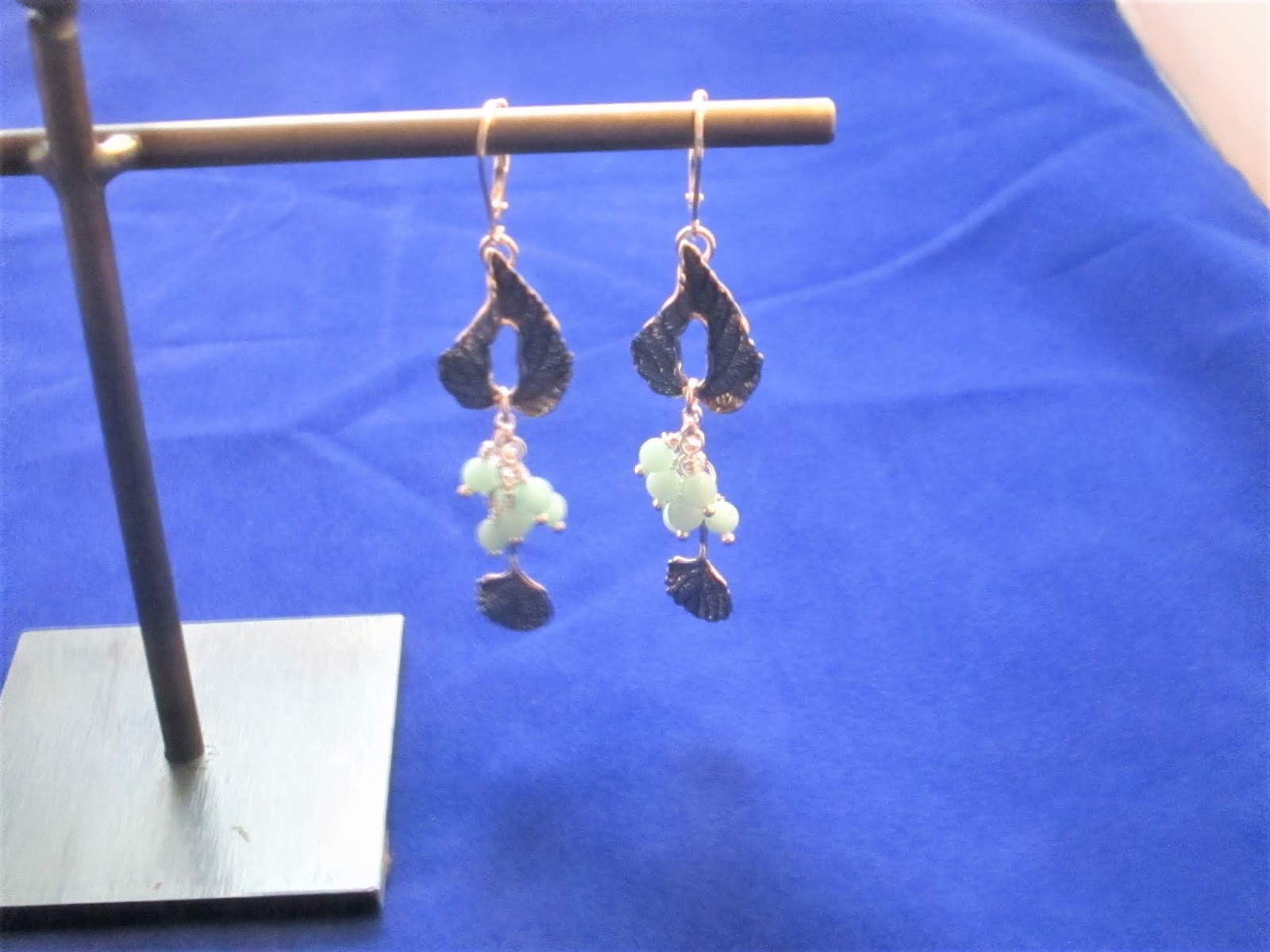
I was inspired to make this first piece by a pictures I saw online of vintage silver earrings.  The earrings looked like grape leaves with clusters of silver grapes dangling freely.  (Unfortunately, I haven't been able to find the exact image to share).  I realized that remaking those earrings would be pretty challenging with the materials and equipment I had on hand, but I thought I could at least take the leaf and cluster idea and translate them to something else.

While I was mulling this over, I realized that a few years ago, I bought several toggle clasps that look like leaves. 

Open toggle clasp...

And closed toggle clasp
Unfortunately, as cool as these look, they worked terribly as actual toggle clasps.  I tried making two different designs with them, and they kept coming open while I was wearing the necklaces.  NOT a good thing, unless you enjoy losing your jewelry.  One of the companies I buy supplies from has a precious metal scrap recycling program, and I thought these clasps were destined for that.

But then it occurred to me that they did look like leaves, and I was thinking of making silver leave earrings.  I connected the two parts of the toggle clasp with a short length of chain, added some stone beads to create a cluster of something (grapes?  berries), and added earring wires.  Voila!

Surprisingly lightweight and comfy
Continuing the plant theme, I've had a silver flower pin in my stash for several years.  I bought it at a thrift shop with the idea of turning it into a pendant, and I finally did!


This last piece incorporates an interesting shell fragment I picked up on the beach in North Carolina.  I often find thick shell fragments with multiple holes there, and I had been thinking it would be interesting to try to incorporate them in jewelry.  I picked up one with some purple on it.  But then after I brought it home, it sat around for a while because I wasn't convinced I could make a necklace I liked out of it.  Once I finally did, though, I was pretty pleased.

I think the polished fluorite beads and silver help to elevate the somewhat rough looking shell.  I don't know how durable this shell pendant will turn out to be--it's possible that the beading wire I strung  it on will wear away at it over time--but there is no way to know without trying, and I'll enjoy this necklace for as long as it lasts.


Friday, May 29, 2020

Pandemic Daze: Taking Standardized Tests From Home

So, to get the good news out of the way, I graduated with an MS in speech-language pathology!  I thought about writing a post about graduation during the pandemic, but decided there wasn't all that much to say about it.  My institution canceled the actual graduation ceremony this year, but (a) I think nearly every institution did the same thing, and (b) I wasn't actually planning to attend graduation anyway.  I do feel sorry for people who were looking forward to it, of course, but I don't feel a personal sense of loss for not having it.

Anyway, aside from finding a clinical fellowship, another task awaited me:  the speech-language pathology Praxis exam.  For those who may not know, that's one of the expensive standardized tests that is normally taken at a testing center.  Many of my classmates took it during winter break, to take advantage of time off and having recently prepared for oral comps.  I decided that I would benefit from exposure to the material in my final semester classes, so decided to wait.  At that time, my spring semester internship was scheduled to run through April 15; I planned to take the Praxis after I was done with that.  I'm sure everyone can see where this is going.  My internship ended several weeks early due to the pandemic and testing centers mostly closed.  I started halfheartedly reviewing for the Praxis, but honestly, it was hard to feel motivated when I had no idea when I might be able to take it.

Well, earlier this month, ETS decided to allow people to take many Praxises (Praxi?) at home.  I decided to sign up since I wanted to get it done and had no idea when I might be able to access a testing center.  I took it today, and felt like it actually went pretty smoothly!  There were various security procedures, such as showing my ID and allowing the proctor to take control of my computer to make sure all programs were closed.  I also had to use my webcam to pan around the room and show the proctor the room around me and the (cleared) table I had my computer on.  We also couldn't talk or have anyone enter the room while we were testing.  Scott had to run a rare outside errand this morning, and we agreed that I'd text him when I was done.  I was concerned about Stella waking up from her nap and coming into the room and meowing loudly (or worse--jumping on the table and trying to walk across my keyboard), but fortunately that didn't happen.  It occurred to me as I was working on the test that I probably should have just blocked off a section of the apartment to keep her from interfering, so I'll just leave that as a tip for other pet owners who may need to take a Praxis from home.

The only thing I didn't like is that I didn't really know what to expect on testing day.  So, for anyone else who might need to do this, it's pretty easy.  You have to sign in to the Proctor-U account that you created when you scheduled your test.  There will be a countdown showing how much time you have before the test is scheduled to begin.  Then you be allowed to start.  You'll be connected to a proctor who will walk you through everything you need to do.  The proctor will then log on to the ETS browser you had to download to take the test and let you get started.  It was pretty seamless after that.  I know a proctor was watching me virtually from afar, but since I never saw them, it wasn't a distraction.

I won't feel officially out of the woods until I get my official score report, but the score I was given at the end appears to be a comfortably passing one, and if there were any problems, I wasn't aware of them.  I don't know how long people will be allowed to take standardized tests at home; maybe if it works well enough it will continue, but this also might become an experience emblematic of these unusual times.

Friday, April 24, 2020

Pandemic Daze: Exercise

One interesting aspect of staying at home and having non-essential businesses closed is how it changes your exercise patterns.  Under normal, non-pandemic circumstances, I get a fair amount of walking each day to and from mass transit.  Now, I'm hardly going anywhere at all (and I'm heeding Metro's pleas to not ride unless absolutely necessary), so that's gone.  I also typically did more formal workouts a few times a week.  Up until winter break, I was using my apartment complex's fitness center.  Then, after deciding that I needed to up my fitness game a bit, I joined a kickboxing gym.  As the public perception of the pandemic began to change, my apartment complex closed our fitness center.  The gym I joined voluntarily closed hours before our governor ordered all gyms to close.

One of the first things Scott and I did when it started to look like we'd be hunkering down for a while was to order some hand weights and a kettle bell.  It took a while for them to come in and Scott mentioned that he thought the hand weights would normally have been less expensive, so I suspect others had the same idea.  On my last "normal" day (i.e., the last day I ventured more than a couple miles from my apartment), I saw a Peloton bike (of the ad fame) being delivered in a ritzy neighborhood, so maybe there was a run on higher-end fitness equipment, too.

My gym has been creating daily workout videos for people to do at home.  None of them require equipment, although you can sometimes incorporate things like hand weights if you have them.  We've been trying to do three of those workouts per week, and while it's not exactly like going to the gym, they're pretty good.  I do miss the uncluttered padded floors of the gym, though--no furniture to rearrange there, and no rough carpeting for floor exercises!  Also, at home, we sometimes get a feline interloper who wants to know what all the commotion is about.

We're taking long walks most days, too.  We usually walk through a nearby residential neighborhood to a trail and then walk on the trail.  The problem is that the trail is sometimes pretty crowded and there's not a lot of room to avoid other people, but we do our best.

Playgrounds here have been closed; the ones near us are surrounded in that orange flexible fencing.  This doesn't directly impact us, but I do feel sorry for the kids, especially ones who don't have yards to play in.  I'm starting to see more kids on the trail we walk on, possibly because it's one of the few places left where they can let off some steam.

I'm glad that the existing restrictions have still allowed for people to get exercise outdoors.  It'll be interesting to see what happens as restrictions ease up--I kind of doubt gyms or team sports will be among the first restrictions to be lifted, and I think most people are fearful enough that there won't be too many volunteers to be first to go into a non-essential crowded situation.

Wednesday, April 15, 2020

Pandemic Daze: Face Masks

Anybody else suffering from mental whiplash from all the contradictory advice we're getting in the time of covid-19?  Like how wearing face masks was utterly pointless and possibly socially irresponsible until it wasn't?

I am definitely NOT providing any medical advice in this post.  I also don't want to upset anyone at such a sensitive time.  But I will say that I am unconvinced by the utility of most people wearing face masks, especially of the DIY variety.  I'm willing to be persuaded to think otherwise, if anyone has evidence they'd like to share.  But the usual explanation I hear is that various Asian countries where face mask-wearing is widespread have had lower infection rates than the US.  I would argue that that evidence shows correlation, not causation, and that the countries in question also did other things differently.

Also, I worry about some of the wider implications of encouraging everyone to wear face masks.  Sure, they tell us to make our own and leave the "real" face masks for medical personnel.  But is it really that much of a leap in logic to think that if people are being told to wear face masks that they might try to get ahold of good ones to wear rather than, say, cut up a t-shirt for a no-sew DIY mask?  I also worry that people might put too much faith in the efficacy of face masks and become more lax about measures like physical distancing.

Also, to be honest, I'm just very upset at how this whole crisis has been managed.  With two months of warning time, I suspect lots of medical-grade face masks could have been manufactured, possibly enough for (gasp!) our medical personnel to have all the masks they need.  Maybe even enough for the rest of us to use them!

All of that being said, my county has started requiring people to wear a face mask in supermarkets, pharmacies, and various other establishments.  I'm not getting out all that much these days, but I'm still making weekly supermarket trips, so I finally broke down and sewed a few masks over the weekend.  We wore them to the supermarket for the first time today, and I thought they were fairly tolerable.  We could breathe through the fabric and they didn't slip much.  When we were standing in line to get in to the supermarket, the guy behind us complimented our masks very enthusiastically; he liked the fact that they wrapped around our faces to our ears.  Upon learning that I had made them, he told me I was the MVP. 

I wonder how it will feel, at some distant point in the future, when wearing a face mask in public becomes an anomaly again.  I remember when I left a job where it was absolutely essential to have my employee badge every day.  For months after I left, I kept having these brief spells of panic looking for it in my purse, only to remember that I didn't need it anymore and had turned it in on my last day.  I wonder if similar mask panic is in my future, and if so, when.